
Human Design: What If There Is No Universal Formula?
Have you ever discovered something about yourself and suddenly thought: “Ohhh… maybe that’s why I do that.”?
I love those moments. There is something quite satisfying about finding a little piece of the puzzle that makes a behaviour, a reaction or even a certain part of your personality suddenly make a bit more sense.
That is probably what has made me curious about Human Design.
And before I go any further, I should probably add a little disclaimer: I am by no means a Human Design expert. I have probably only scratched the surface myself. There is a lot more to Human Design than what I am going to talk about here, and I am still learning and figuring things out.
But even that little bit has already given me some surprisingly interesting insights into myself, which is what I want to share.
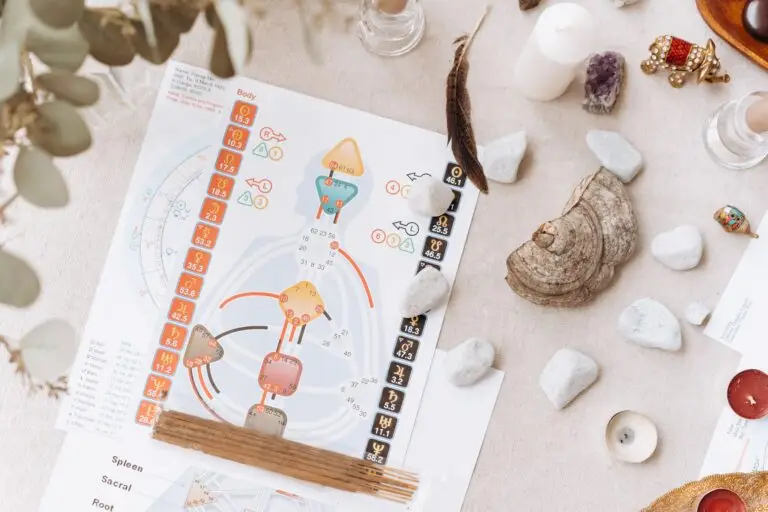
So, what actually is Human Design?
If you have never heard of Human Design before, you might be wondering what I am even talking about.
Human Design is a self-discovery system that brings together elements from different traditions and systems, including astrology, the I Ching, the chakra system and Kabbalah, alongside more modern concepts.
The basic idea is that we are all designed differently. Your Human Design chart is created from your birth information and is meant to give you insights into things like how you use your energy, how you make decisions, how you interact with others and what might feel more or less natural to you.
There is quite a lot to discover, but these are some of the main pieces you will come across:
- Your Type – one of five types: Generator, Manifesting Generator, Projector, Manifestor or Reflector. Each type comes with its own strategy for how you are thought to best interact with the world.
- Your Authority – essentially, your suggested way of making decisions. Depending on your design, this might involve waiting for emotional clarity, listening to your gut response or following another form of inner guidance.
- Your Centres – nine areas of the chart connected to different aspects of our energy and behaviour. They can be defined or undefined and are one of the areas where Human Design looks at how we might be influenced by the people and environments around us.
- Your Profile, Gates and Channels – these add even more detail to your individual design. And this is probably the point where I would say: I am still figuring it out myself.
And that is really just the tip of the iceberg. You can spend a lot of time learning about your individual chart, but what I find most interesting isn’t memorising every part of it. It is when something you read makes you stop and think: “Ohhh… that’s why I do that.”
Not because it suddenly explains your entire personality, but because it gives you another perspective on something you have experienced for a long time.
We are all different — so why do we expect ourselves to work the same way?
I think we are surrounded by formulas for how we are supposed to live.
Wake up at 5am. Be more productive. Exercise every morning. Meditate for 20 minutes. Say yes to opportunities. Put yourself out there. Make decisions rationally. Push yourself harder. Don’t overthink. Be more confident. Be more disciplined.
And if you spend enough time online, you can find a pretty convincing argument for almost any of these things.
The problem is that they can all work beautifully for one person and be completely wrong for another.
Maybe waking up at 5am makes someone feel like they have conquered the day, while you are barely functioning until your second coffee. Maybe one person gets energy from being surrounded by people, while another needs a quiet evening alone to recharge. Maybe making a quick decision feels liberating to one person, while another genuinely needs time to sit with a decision before knowing what feels right.
We know that people are different, yet we still spend so much time comparing ourselves to each other and wondering why we don’t seem to work the same way. And sometimes we don’t just notice the differences. We judge ourselves for them.
Maybe we call ourselves lazy when we actually need a different rhythm. Maybe we think we are indecisive when we simply need more time before something feels right. Maybe we think we are too sensitive when we are simply affected by things more deeply than someone else.
This is where I find the idea behind Human Design interesting. It starts from the premise that there isn’t one universal blueprint for how people should operate.
And honestly, that idea isn’t exactly revolutionary. We already know that people are different. But knowing it intellectually and actually giving yourself permission to be different are two very different things.
A mirror, not a manual
This is probably the best way I would describe my approach to Human Design.
A mirror, not a manual.
I don’t want a chart to tell me who I am or give me a list of instructions for how I am supposed to live my life. I am much more interested in using it as something that makes me look a little closer at myself. Because ultimately, you know yourself better than any chart does.
Human Design can give you something to reflect on, but you get to decide whether something resonates with you or not.
And I actually like that approach to self-discovery in general. We can explore astrology, personality tests, Human Design, meditation, journaling or any number of other tools without having to turn them into absolute truths.
Take what makes you think. Keep what feels meaningful. Leave what doesn’t.
Maybe that is the real value of exploring things like Human Design. Not finding another box to put ourselves in, but becoming a little more curious about the person who is already there.
Because perhaps there really isn’t a universal formula for being you. And maybe there isn’t supposed to be.
Want to explore Human Design yourself?
If this made you curious and you want to dig a little deeper, here are a few places to start. I’m still learning myself, so consider these a starting point rather than a definitive guide.
🎥 Watch: Human Design: An Introduction with Ra Uru Hu
📖 Read: Living Your Design by Lynda Bunnell
🌐 Explore: The Jovian Archive Beginner Hub